
Projects: KSAH

Korean Study of Adolescent Health(KSAH)
The Korean Study of Adolescent Health (KSAH) is a cohort-based longitudinal study that integrates sociogenomic data, repeated neuroimaging, and sociocentric peer-network measures with repeated assessments of adolescent mental health and related psychosocial characteristics. KSAH is designed as a multi-level research infrastructure that supports longitudinal analyses of how genetic predispositions, neurodevelopmental processes, and dynamic peer relationships jointly shape a broad range of outcomes, including subjective well-being, perceived stress, anxiety and depressive symptoms, sleep and eating-related problems, and other domains of adolescent adjustment.
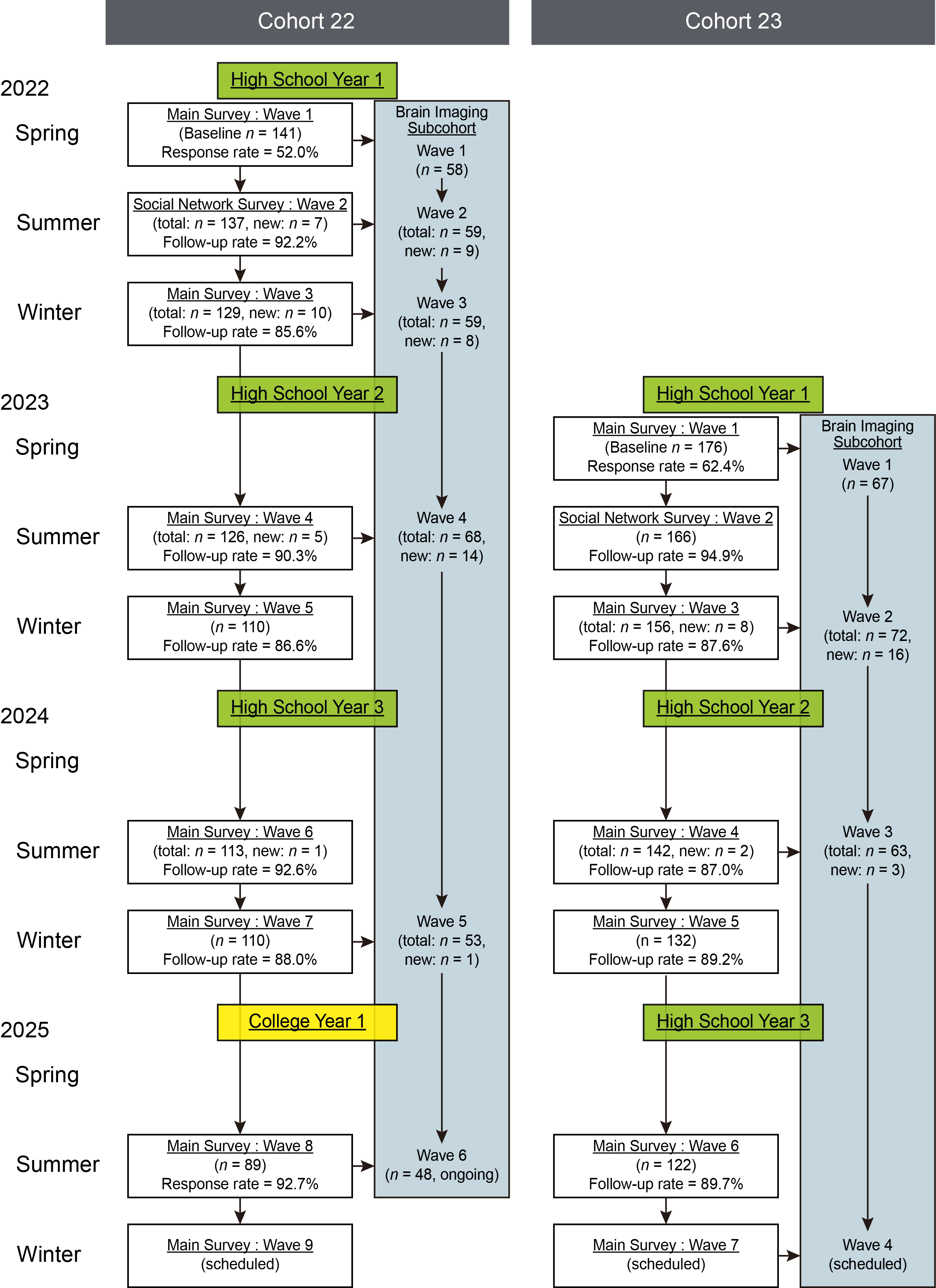
KSAH comprises two primary cohorts (Cohort 22 and Cohort 23) recruited from a single-sex girls’ high school, with repeated survey waves conducted during the high-school period and planned follow-up into emerging adulthood. Baseline data collection is implemented in the school setting, complemented by face-to-face interviews and mobile-based follow-up surveys. Genomic DNA is collected via an in-person protocol. The survey instrument covers not only mental health but also family and educational contexts, validated psychological scales, and a wide range of psychosocial attitudes and beliefs.
To characterize adolescents’ social environments, KSAH employs a discussion-network name generator (up to seven alters) that records real names and in-school identifiers (e.g., grade/class), enabling the reconstruction of grade-level sociocentric networks and the analysis of network change over time. These social-network data are paired with repeated MRI sessions that include structural imaging (e.g., T1-weighted and diffusion imaging) and functional imaging (resting-state and multiple task paradigms, including face-viewing and naturalistic movie-watching). Together, these modalities provide an integrated platform for investigating how peer social structure and social-cognitive processes are instantiated in the brain and how they relate to trajectories of mental health across adolescence.
[Key Data Components]
- 1) Genetics
- - DNA collection via oral epithelial cell swabs from inside the cheeks (kit-based protocol) (N = 235, 2 cohorts)
- - Genome-wide SNP data (~500,000 variants) using Korean-optimized genotyping arrays
- - Polygenic risk scores (PRS) derived from GWAS summary statistics
- 2) Brain Imaging
- - Structural MRI (T1, DTI) and functional MRI (resting-state and task-based)
- - Face-viewing and movie-watching paradigms to capture social and emotional processing
- - More psychological experiments inside MRI scanner: gamble, prosocial learning, social distancing, etc.
- - Repeated measurements enabling developmental trajectory analysis
- 3) Social Network Data
- - Real-name peer discussion networks (name generator) enabling grade-level sociocentric reconstruction, complemented by in-school relationship measures (e.g., popularity/negative ties).
- - Longitudinal network tracking of network dynamics, reciprocity, and structural change
- 4) Mental Health Measures
- - Repeated measures of core mental health domains—depressive symptoms (PHQ-9), anxiety (GAD-7), perceived stress (PSS-10), and eating-disorder—given their prominence among female adolescents
- - Additional assessments on alcohol use, cigarette smoking, and insomnia from emerging adulthood onward
- - Tracking changes in happiness and broader subjective well-being alongside mental health outcomes across the entire study period